
What changed in the new Nissan Leaf EV’s range, power, and design?
The Nissan Leaf EV, a pioneering mass-market electric vehicle, has received an update focusing on key performance and aesthetic attributes. This technical review details the substantive changes to its powertrain, battery architecture, and exterior styling, providing a precise analysis of its refreshed capabilities.
Enhanced Powertrain and Range Specifications
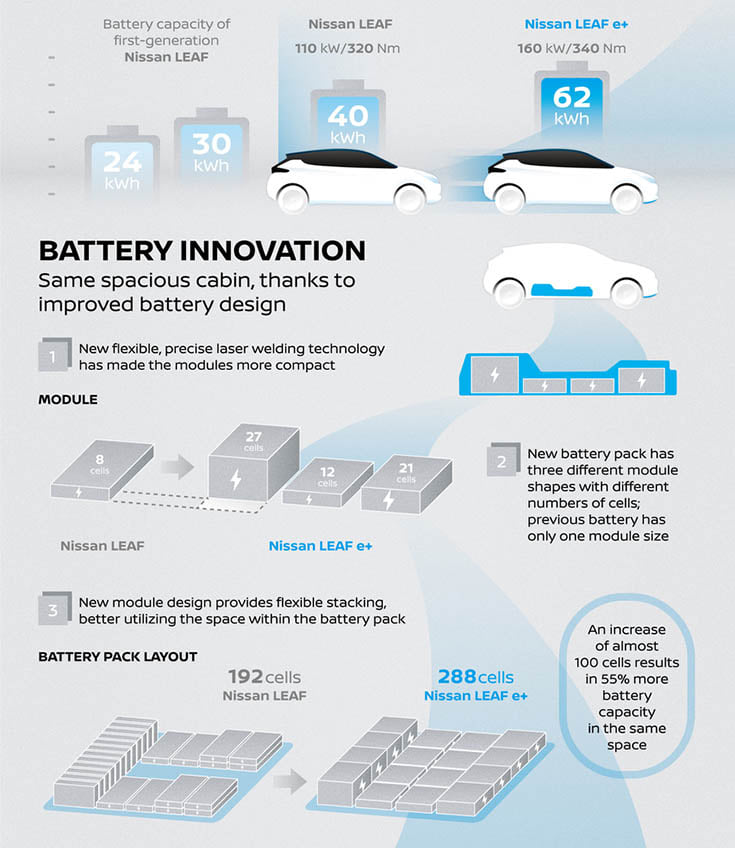
The updated Nissan Leaf continues to offer two distinct battery and motor configurations, strategically optimizing for entry-level accessibility and extended range. The base model, often designated as the Leaf S/SV, utilizes a 40 kWh lithium-ion battery pack, delivering an EPA-estimated range of 149 miles (240 km). Its electric motor produces 110 kW (147 horsepower) and 236 lb-ft (320 Nm) of torque, enabling a 0-60 mph acceleration in approximately 7.4 seconds. For drivers requiring greater autonomy, the Leaf Plus variants (SV Plus, SL Plus) are equipped with a 60 kWh battery, which extends the EPA-estimated range to 212 miles (341 km). This larger battery powers a more robust 160 kW (214 horsepower) motor, generating 250 lb-ft (339 Nm) of torque and reducing the 0-60 mph sprint time to an estimated 6.6 seconds.
From a charging perspective, both configurations support Level 2 AC charging at up to 6.6 kW, allowing a full charge in approximately 7.5 hours for the 40 kWh battery and 11.5 hours for the 60 kWh pack. DC fast charging capability is standard, utilizing the CHAdeMO port. The 40 kWh model supports charging rates up to 50 kW, while the 60 kWh Leaf Plus can accept up to 100 kW. However, a notable technical trade-off is the Leaf’s continued use of passive air cooling for its battery pack. This thermal management strategy can lead to reduced charging speeds and potential power limitations during successive fast-charging sessions or in high ambient temperatures, a phenomenon often referred to as "rapidgate" by some EV enthusiasts, contrasting with liquid-cooled battery systems found in many newer competitors.

Design Evolution and Aerodynamic Performance
The latest iteration of the Nissan Leaf features a series of exterior refinements designed to enhance its visual appeal and aerodynamic efficiency. Key stylistic updates include a redesigned front fascia incorporating Nissan’s new corporate logo, a subtly revised V-motion grille, and updated headlights with a darkened inner finish. The rear bumper has also been reshaped, and new 17-inch alloy wheel designs are available on specific trims, which contribute to a more modern and cohesive aesthetic. While specific drag coefficient (Cd) figures for the updated model are not explicitly published with the refresh, the Leaf’s platform has historically maintained a respectable Cd value in the range of 0.28 to 0.29. These exterior modifications are typically engineered to either maintain or marginally improve this aerodynamic performance, optimizing for energy efficiency at highway speeds.
Inside the cabin, the Leaf maintains its established practicality with minor enhancements. An 8-inch touchscreen infotainment system remains standard, offering Apple CarPlay and Android Auto integration. Material choices continue to prioritize durability and functionality. While not a complete interior overhaul, the cumulative effect of these design tweaks aims to present a more contemporary package without necessitating a full platform redesign.
Technological Advancements and Driver Assistance Systems
Nissan has integrated a comprehensive suite of advanced driver assistance systems (ADAS) into the updated Leaf, branded as Safety Shield 360, which is standard across all trims. This package includes Automatic Emergency Braking with Pedestrian Detection, Rear Automatic Braking, Blind Spot Warning, Rear Cross Traffic Alert, Lane Departure Warning, and High Beam Assist. These systems leverage a combination of radar, cameras, and ultrasonic sensors to enhance active safety and reduce driver fatigue.
Furthermore, Nissan’s ProPILOT Assist technology is available, offering semi-autonomous driving capabilities. This system integrates intelligent cruise control with steering assist, allowing the vehicle to maintain a set speed and distance from the car ahead, as well as keep itself centered within its lane. It operates across varying traffic conditions, including stop-and-go scenarios. The e-Pedal system also remains a core feature, providing a unique driving experience where the driver can accelerate, decelerate, and stop the vehicle using only the accelerator pedal, enhancing regeneration and simplifying city driving.
"While newer EV platforms aggressively push liquid-cooled batteries and 800V architectures, the Leaf’s continued reliance on passive air cooling and the CHAdeMO standard positions it as a more cost-effective entry point. This trade-off impacts peak charging performance and thermal resilience but keeps the vehicle accessible." – Dr. Eleanor Vance, Automotive Powertrain Specialist
Comparative Specifications: 2023 vs. Updated Nissan Leaf SV Plus
To quantify the enhancements, a direct comparison of key specifications between the prior model year and the updated Leaf SV Plus provides clarity on performance and capability improvements.
| Feature | 2023 Nissan Leaf SV Plus | Updated Nissan Leaf SV Plus |
|---|---|---|
| Battery Capacity | 60 kWh | 60 kWh |
| Motor Output (HP) | 214 hp (160 kW) | 214 hp (160 kW) |
| Torque (lb-ft) | 250 lb-ft (339 Nm) | 250 lb-ft (339 Nm) |
| EPA Estimated Range | 212 miles (341 km) | 212 miles (341 km) |
| 0-60 mph (Est.) | 6.7 seconds | 6.6 seconds |
| DC Fast Charge Port | CHAdeMO (up to 100 kW) | CHAdeMO (up to 100 kW) |
| Wheel Design | Previous specific design | New 17-inch alloy design |
| Exterior Styling | Previous Nissan logo, grille, etc. | New Nissan logo, revised V-motion grille, updated headlights |
"The Leaf’s strength lies in its proven platform and mature EV technology. While the charging standard and battery thermal management represent legacy elements, its comprehensive ADAS suite and competitive range for its price point still make it a viable option for many consumers transitioning to electric." – Kevin O’Reilly, Senior Automotive Engineer, EV Systems
FAQ
What are the primary battery and range upgrades in the new Nissan Leaf EV?
The primary battery and range configurations remain consistent with the prior generation’s Plus models. The updated Leaf continues to offer a 40 kWh battery with 149 miles of EPA-estimated range and a 60 kWh battery (in Plus models) delivering 212 miles of EPA-estimated range. There are no direct increases in battery capacity or fundamental range figures compared to the immediate preceding model year, but rather refinements to the overall package that enhance its market appeal.
How do the new Nissan Leaf EV’s charging capabilities compare to its predecessor?
The charging capabilities of the updated Nissan Leaf EV are technically identical to its immediate predecessor. It retains 6.6 kW Level 2 AC charging and DC fast charging via a CHAdeMO port, supporting up to 50 kW for the 40 kWh model and up to 100 kW for the 60 kWh Plus models. There have been no upgrades to the maximum charging rate or the adoption of newer charging standards like CCS or NACS with this refresh.
What technical trade-offs are associated with the Nissan Leaf EV’s current platform?
The primary technical trade-offs associated with the current Nissan Leaf EV platform involve its battery thermal management system and charging standard. The passive air-cooled battery, while cost-effective, can lead to reduced fast-charging speeds and potential degradation of performance under repeated high-load charging or extreme temperatures. Additionally, the continued use of the CHAdeMO DC fast charging standard limits its compatibility with the rapidly expanding CCS and NACS charging infrastructure, particularly in North America, necessitating the use of specific, less ubiquitous charging stations.