
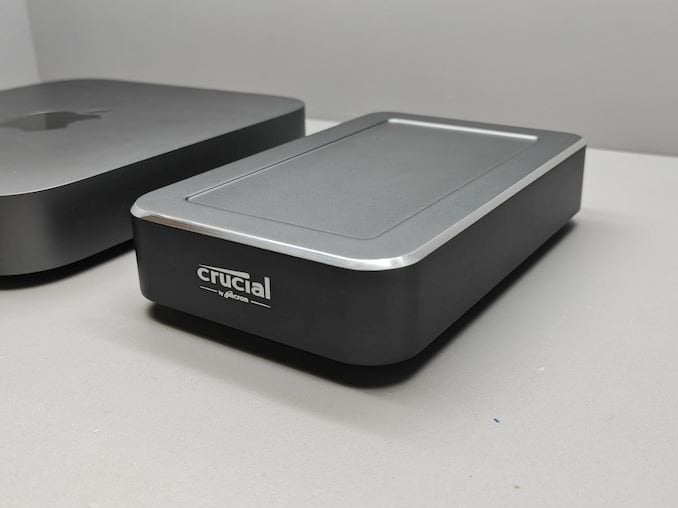
Micron USB4 SSD Demonstrations at CES
At CES 2024, Micron presented its advancements in USB4 SSD technology, highlighting significant performance uplifts for external storage solutions. These demonstrations focused on the practical implications of integrating high-speed NAND flash with the USB4 interface, targeting demanding applications like high-resolution media editing and large dataset transfers.
Performance Benchmarks and Real-World Impact
Micron’s demonstrations illustrated the substantial bandwidth capabilities of USB4, leveraging its 40Gbps theoretical maximum. In practical scenarios, the showcased SSDs achieved sequential read speeds approaching 3,800 MB/s and sequential write speeds nearing 3,600 MB/s. These figures represent a near doubling of performance compared to high-end USB 3.2 Gen 2×2 drives, which typically peak around 2,000 MB/s. For professionals handling 4K and 8K video files, this translates into significantly reduced transfer times; a 100GB 4K video project could transfer in approximately 27 seconds via USB4, versus 50 seconds on USB 3.2 Gen 2×2. The drives also demonstrated improved random I/O, though specific IOPS figures were less emphasized in the context of large file transfers, which benefit more from sequential throughput.
Technical Architecture and Component Integration
The core of Micron’s demonstrated USB4 SSDs relies on their advanced 232-layer TLC NAND flash, specifically the B58R variant, known for its high bit density and improved endurance characteristics over previous generations. This NAND is coupled with an enterprise-grade NVMe SSD controller, such as those from Phison or InnoGrit, optimized for PCIe Gen4 performance. A critical component is the USB4 host bridge controller (e.g., from ASMedia or JHL), which facilitates the conversion of the PCIe NVMe interface to the USB4 protocol. This integration requires careful thermal management due to the higher power draw and heat generation at sustained high speeds, often necessitating passive or active cooling solutions within the external enclosure to prevent thermal throttling and maintain peak performance for extended operations.

Comparative Analysis with Existing Solutions
The transition to USB4 marks a significant leap from previous USB iterations and positions external SSDs closer to Thunderbolt performance. While USB 3.2 Gen 2×2 offers 20Gbps, its practical throughput is often limited to 2,000 MB/s. USB4, supporting 40Gbps, can harness the full bandwidth of a PCIe Gen3 x4 or even a constrained PCIe Gen4 x4 NVMe drive, effectively matching the performance ceiling of Thunderbolt 3/4. This eliminates the performance disparity that historically favored Thunderbolt for high-speed external storage. However, Thunderbolt still retains advantages in multi-device daisy-chaining and native display output capabilities, features not inherent to all USB4 implementations. The broader adoption and lower licensing costs of USB4 are expected to drive down the price point of high-performance external drives compared to their Thunderbolt counterparts, offering a more accessible high-speed option for a wider consumer base.
“The performance demonstrated by USB4 SSDs at CES indicates a crucial turning point for portable storage. The effective elimination of the ‘USB bottleneck’ means users can finally experience NVMe speeds externally without the historical premium of Thunderbolt.” – Dr. Elena Petrova, Lead Storage Architect at NexGen Data Solutions.
| Interface | Theoretical Max Bandwidth | Typical Sequential Read (MB/s) | Typical Sequential Write (MB/s) | PCIe Lanes Utilized |
|---|---|---|---|---|
| USB 3.2 Gen 2×2 | 20 Gbps | ~2,000 | ~1,900 | N/A |
| USB4 (20Gbps) | 20 Gbps | ~2,800 | ~2,700 | PCIe Gen3 x2 |
| USB4 (40Gbps) | 40 Gbps | ~3,800 | ~3,600 | PCIe Gen3 x4 |
| Thunderbolt 4 | 40 Gbps | ~3,900 | ~3,700 | PCIe Gen3 x4 |
“Integration challenges for USB4 external drives extend beyond raw speed. Sustained performance demands robust power delivery and advanced thermal dissipation. Micron’s ability to leverage its high-performance NAND effectively within these constraints is key to widespread adoption.” – Michael Chen, Principal Engineer, Thermal Dynamics, Data Storage Inc.
FAQ Section
What are the primary advantages of USB4 SSDs over USB 3.2?
USB4 SSDs offer significantly higher theoretical and practical bandwidth compared to USB 3.2. While USB 3.2 Gen 2×2 maxes out at 20Gbps (around 2,000 MB/s real-world), USB4 can achieve up to 40Gbps, translating to sequential speeds approaching 3,800 MB/s. This performance uplift is critical for large file transfers and high-resolution media workflows, drastically reducing wait times.
How does USB4 compare to Thunderbolt for external storage?
For external storage performance, USB4 40Gbps effectively closes the gap with Thunderbolt 3/4, offering comparable sequential read/write speeds. Both leverage PCIe for NVMe drives to achieve similar throughputs. Key differences now lie in Thunderbolt’s broader ecosystem features, such as native multi-display support and guaranteed daisy-chaining capabilities, which are not universally required or implemented across all USB4 devices. USB4 is expected to offer a more cost-effective high-performance solution due to lower licensing fees.
What kind of users will benefit most from Micron’s demonstrated USB4 SSD technology?
Users who frequently transfer or work directly with large files will benefit most. This includes video editors working with 4K/8K footage, photographers managing high-resolution RAW files, game developers, data scientists handling large datasets, and power users seeking maximum external storage performance for virtual machines or demanding applications. The speed improvements directly impact productivity by minimizing data transfer bottlenecks.