Food processing robots can take on repetitive work such as picking, packing, inspection, and palletizing. The business opportunity appears when a robot solves one costly task often enough to cover its price, service, and integration work.
For a food manufacturer, the first question is practical: which task is slow, hard to staff, or unsafe to repeat? That question gives the project a starting point.
Quick read
- Start with one task and measure its current labor, downtime, and error costs.
- Food contact, washdown, product changes, and worker safety shape the robot choice.
- A pilot needs a pass rule tied to output, uptime, quality, and payback.
Where the work is
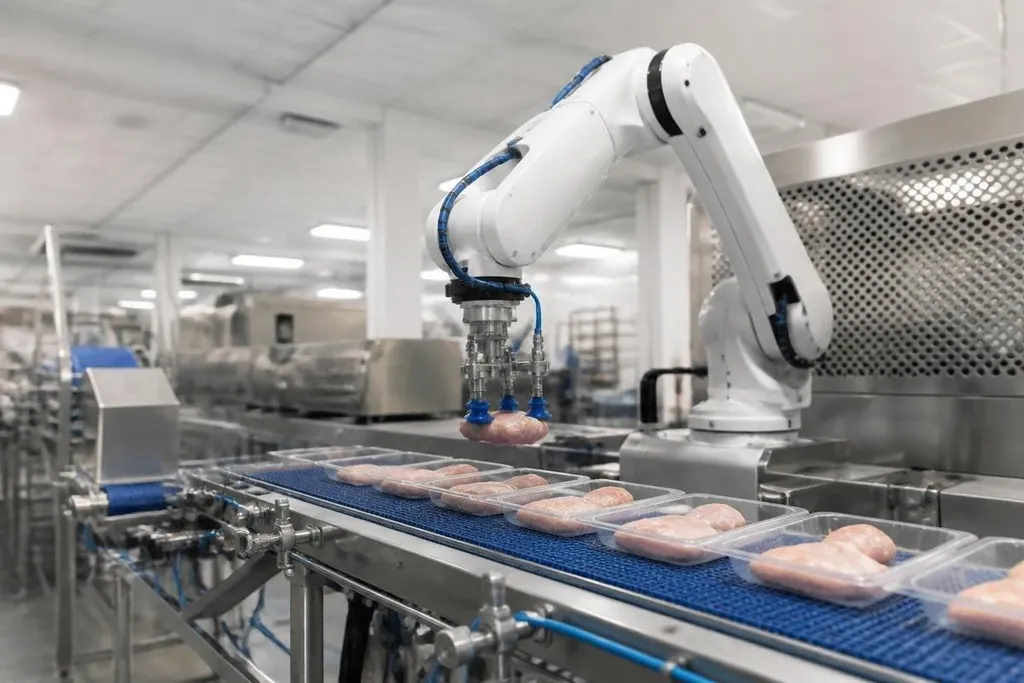
Picking and packing are clear places to look. A robot arm can move products into trays, cartons, or containers, while a vision system checks position, size, or visible defects. The exact setup depends on the product’s shape, surface, weight, and speed on the line.
Palletizing offers another path. The palletizing cell can place cases onto pallets in a fixed pattern, which may reduce repeated lifting for workers. The value depends on case weight, pallet height, line speed, and how often the product pattern changes.
Inspection can also support a business case. Cameras can check labels, seals, fill levels, or package position while products move through the line. That check works best when the defect is clear enough for the camera and lighting to detect it.
Cleaning and sanitation create a harder opening. Food plants use water, chemicals, and strict cleaning routines, so equipment needs the right enclosure and washdown rating. A robot that handles the task may still need a person to prepare the area, verify the result, or fix blocked equipment.
What makes the market difficult
Food products change. A line may handle different sizes, textures, packaging materials, or recipes across one shift. A gripper that works on a rigid carton may struggle with a soft bag or a wet product, so a machine built around one product can lose value when the schedule changes.
The robot also needs space, controls, guarding, sensors, and a link to the existing line. That integration work can cost more time than the arm itself.
The buyer should price the full cell, including installation, training, maintenance, spare parts, and production downtime during setup. Those costs decide whether the robot can earn back its purchase price.
Food safety adds another layer. Any part that touches food needs suitable materials and cleaning procedures. The plant must also set rules for access, emergency stops, fault recovery, and manual work near the robot.
That planning needs evidence from a working food plant, not a short demo. Food processing robotics reporting can put the site, robot task, test date, and result beside the business case, giving suppliers a sound basis for pricing the work.
Where suppliers can build a business
The market is wider than selling robot arms. Suppliers can make money from task-specific grippers, vision systems, washdown-ready cells, line controls, maintenance, and worker training. Software that helps a plant change product settings may matter as much as the robot hardware.
Service contracts can create repeat income after installation. A food plant may need planned maintenance, replacement parts, remote fault checks, and help when a new product enters the line. Those needs also give smaller automation firms a place in the market, especially when they understand one type of food process well.
For buyers, this means the supplier’s fit matters. Ask who will program the cell, who responds to a fault, and how long common replacement parts take to arrive. A low purchase price has little value if a stopped packing line waits days for support.
A practical buying check
Use these points before asking for a full quote:
- Name the task: Record the product, case weight, cycle time, shift pattern, and changeovers.
- Set the pass rule: Choose the output, quality rate, uptime, and recovery time the cell must meet.
- Price the whole cell: Include guarding, conveyors, grippers, cameras, controls, installation, training, and service.
- Test product changes: Run the hardest package, smallest format, wettest surface, and planned changeover.
- Check the room: Confirm floor space, power, air, drainage, washdown needs, and worker access.
- Set the exit: Decide when the pilot stops, changes, or moves into production.
I'd start with a packing or palletizing task that already has stable product flow, clear output data, and a known labor cost. That gives the robot a fair test before the plant spends money on a wider system.
The next decision should rest on measured production results, not the number of tasks a supplier lists in a slide deck. If the cell cannot meet its pass rule during the pilot, the business case needs a different task or a different machine.